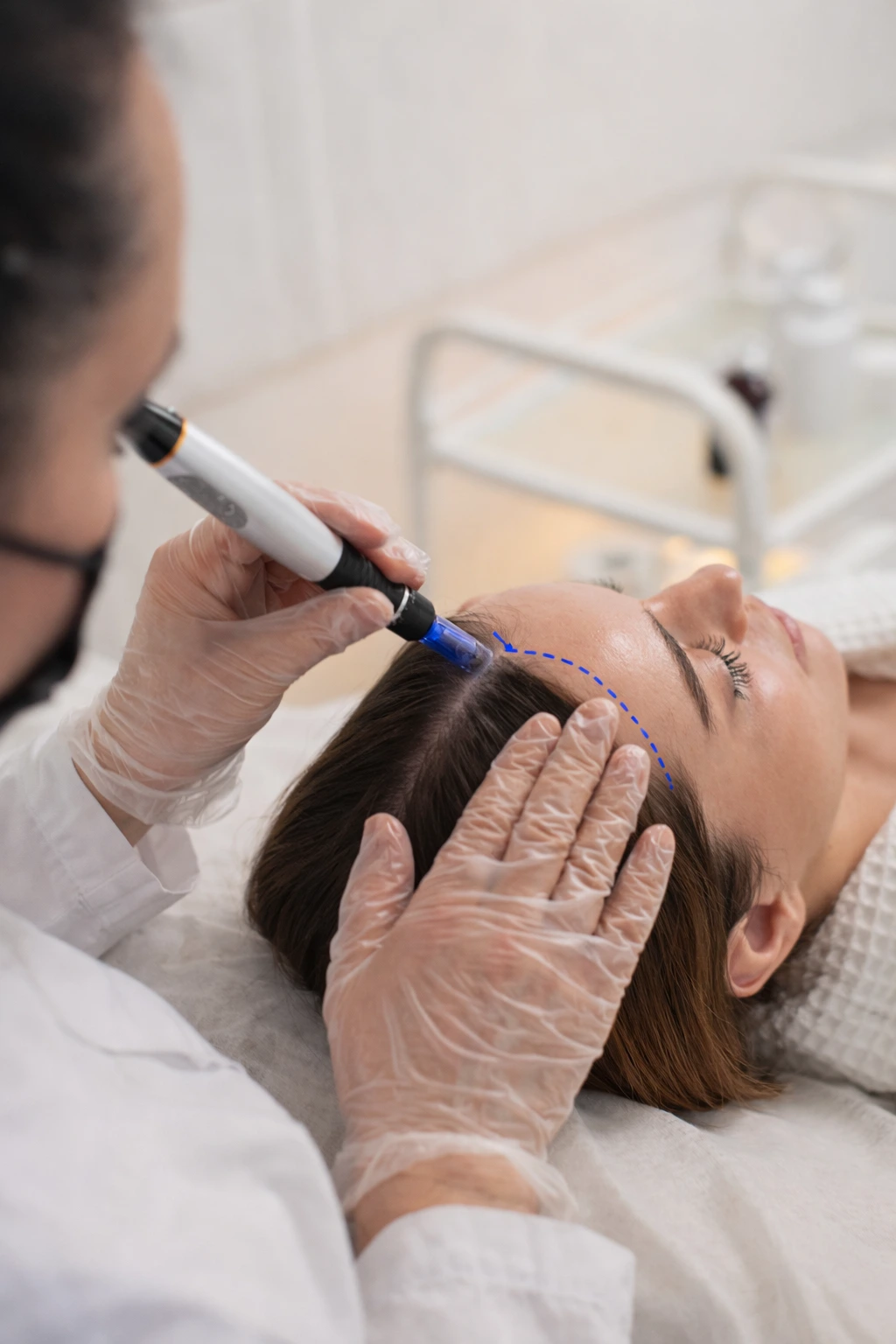
Scalp and hairline lowering surgery, also known as hairline advancement or forehead reduction, is a cosmetic procedure designed to reduce the height of a high hairline and create a more proportionate, balanced facial appearance. During the surgery, the scalp is mobilized, advanced forward, and securely fixed so the hairline sits lower on the forehead. This technique can typically lower the hairline by about 1 to 4 cm, depending on scalp mobility and tissue flexibility. The result is a smaller forehead and a softer, more harmonious facial contour. Scalp lowering is often chosen by individuals seeking facial balance or those undergoing facial feminization and can be combined with other procedures like brow contouring or forehead reshaping for enhanced results.
Scalp and hairline lowering involves carefully mobilizing the scalp and bringing it forward to reduce the visible forehead height. Your surgeon makes an incision along the hairline, advances the scalp forward, and then secures it in its new position, usually with fixation techniques that ensure stability. The extra forehead skin is then removed, and the incision is closed so that the scar lies hidden along the new hairline. The procedure is done under anesthesia and tailored to your specific facial proportions.
Good candidates for scalp and hairline lowering are adults in good overall health who are bothered by a high hairline or disproportionately large forehead that affects their facial balance. Ideal candidates have adequate scalp mobility so the hairline can be advanced without excessive tension. Those seeking facial feminization or a softer appearance are often interested in this surgery. A consultation with a qualified surgeon helps determine whether your anatomy, hair density, and goals make you a suitable candidate.
Many individuals feel self-conscious about a high hairline or a long forehead that makes their facial proportions feel unbalanced. Scalp and hairline lowering surgery offers a way to reposition the hairline lower on the forehead, which can create a more balanced, harmonious facial appearance and enhance overall attractiveness. This procedure is especially popular among those seeking a softer, more feminine contour or as part of facial feminization plans, but it can benefit anyone seeking improved proportion. Because the hairline itself is moved forward rather than just filled with temporary treatments like fillers, the results are long-lasting and natural-looking. The incision follows the new hairline so that scarring is discreet and blends with your hair. Scalp lowering can also be combined with other procedures — such as brow contouring or forehead reshaping — to further enhance the facial aesthetic and achieve a comprehensive result.
Disclaimer: These photos are published for illustrative purposes only to provide information on the nature of the procedure. They do not constitute a guarantee of results.
Years of Combined Experience
0+
Treatments Performed
0+
Client Satisfaction
0%+
Advanced Treatments
0+
Frequently Asked Questions
What is scalp and hairline lowering surgery?
Scalp and hairline lowering is a cosmetic procedure that moves the hairline forward and reduces the height of the forehead. It involves advancing the scalp and repositioning it to create a more balanced, proportionate facial appearance.
How is the surgery performed?
Your surgeon makes an incision along the natural hairline, mobilizes the scalp, and brings it forward to the desired position. Excess skin above the new hairline is removed, and the incision is closed so that the scar lies hidden in the hairline.
Will this leave a visible scar?
The incision is placed precisely along the hairline so the resulting scar is well concealed as hair grows. With proper healing and care, the scar becomes subtle over time and difficult to notice.
How long is recovery?
Recovery typically involves swelling and mild discomfort that improve within a few weeks. Most people can return to normal daily activities within about one to two weeks, with full healing taking a few months.
Can the hairline be lowered permanently?
Yes — once the scalp is advanced and secured in its new position, the lower hairline is permanent. Unlike temporary options like fillers or hair transplants, this surgery gives lasting results for hairline height.
Is hairline lowering the same as a hair transplant?
No — hairline lowering physically moves the scalp forward, while a hair transplant adds individual hair follicles to an existing hairline. Hairline lowering creates immediate change in forehead height, whereas transplants take time for hair to grow.
Who benefits most from this surgery?
Individuals with a high forehead, disproportionate hairline, or those undergoing facial feminization often benefit. Good candidates have sufficient scalp mobility and a realistic goal for forehead reduction.
Request a Consultation
Take the first step toward your surgical goals with a confidential, personalized consultation.
Create an account to access this functionality.
Discover the advantages
We use cookies to ensure that we give you the best experience on our website. If you continue to use this site we will assume that you are happy with it.